


3 Ways Construction Teams Can Increase Technology Adoption
Technology is a major key to improving lean processes and maximizing the construction workforce.





4 min read
Hiring more people still matters in 2026. But for many builders, hiring alone will not solve the capacity problem.
The labor market remains tight: skilled trades are harder to find, wages continue to rise, and every open role takes time to fill. At the same time, schedules keep moving, carrying costs accumulate, and land teams are expected to manage more active communities with the same headcount.
That pressure reframes the question. Instead of asking only, “How do we hire faster?” homebuilders also need to ask, “Where are our timelines leaking inside the workflows we already control?”
For land development teams, those leaks often show up in:
The builders finding more capacity have stopped seeing the labor shortage as a hiring challenge alone and started addressing it as an operating model constraint.
The HBI Fall 2025 Construction Labor Market Report puts a hard number on what builders already feel. The skilled labor shortage costs the U.S. residential construction industry about $10.8 billion per year. That includes about $2.7 billion in higher carrying costs and $8.1 billion in lost single-family production, equal to roughly 19,000 homes not built.
The timing pressure is just as important as the cost pressure. It was found that the labor shortage adds an average of 1.98 months to single-family construction time, with an estimated $2,639 in added carrying cost per home.
The broader labor picture does not offer quick relief. Construction needs 349,000 net new workers in 2026 and 456,000 in 2027 to keep labor supply and demand in balance. 92% of construction firms that are hiring report difficulty filling positions, while 45% say worker shortages have caused project delays.
Recruiting will remain necessary. But the builders that protect schedules will also need to remove the workflow delays their current teams can control.
The average single-family home took 9.1 months from authorization to completion in 2024. Homes built for sale moved faster, at 7.6 months, but the overall average remains almost two months longer than in 2015. NAHB attributes that longer timeline to a more stringent regulatory environment, elevated mortgage rates, and skilled labor shortages.
Some of these forces sit outside a land development manager’s control. A field team cannot rewrite permitting policy or move interest rates. But they can control:
Earthwork makes the point clearly. When grading progress depends on infrequent surveys, teams make decisions with information that may already be stale. If the drift from design between surveys, the problem often shows up later, when the fix costs more and the schedule has less room.
The same pattern appears in layout staking, utility tracking, and recurring inspections. The issue is not only missing labor, but also missing visibility.
Site intelligence gives land development teams a current, shared view of what is happening. In practice, this means:
TraceAir is a site intelligence platform built specifically for homebuilders and land developers. Teams use it to make faster decisions from current site data. The drone flights, processing, and 3D model delivery happen without your team lifting a finger.
The comparison below shows how site intelligence changes the operating model for land development teams.
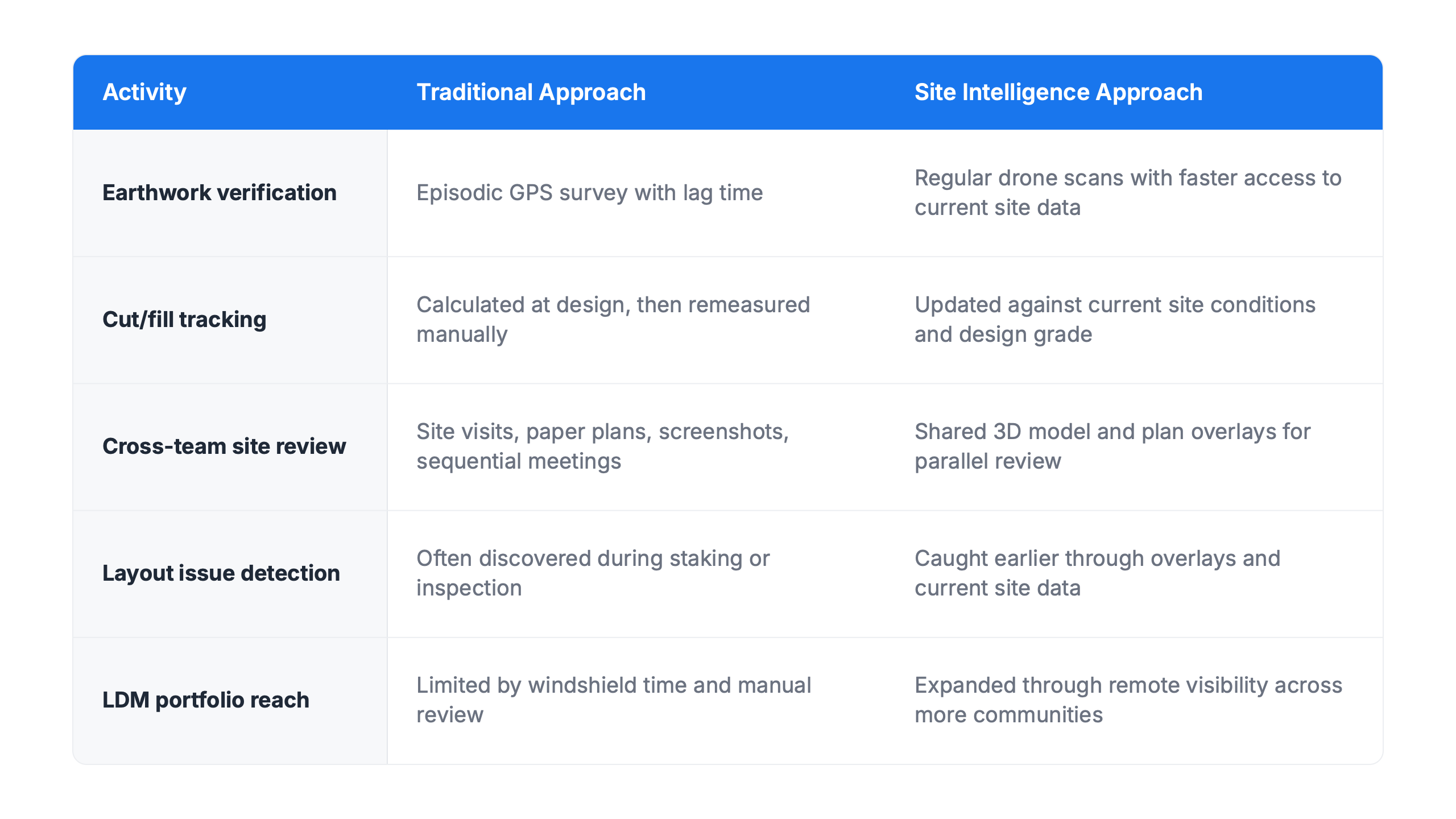
Division leaders can check progress without waiting for a field update. Contractors can align around the same site data.
Project meetings can move from static slides to live site review. Disputes over as-built versus as-designed conditions can be resolved faster because everyone is looking at the same information.
D.R. Horton operates through local divisions across the country. Its Memphis division shows what can happen when project volume grows faster than the systems used to manage land development work.
After the division tripled its homebuilding pace over the years, the existing team was already working at capacity.
Traditional surveys, usually completed at the start and end of a project, left the team with limited visibility into everything that changed between those points. Instead of adding headcount, the team changed how it monitored, reviewed, and shared site data.
TraceAir gave the Memphis division three capabilities its previous workflow could not provide consistently. First, project visibility became continuous, with cut-and-fill volumes, site elevation, and design-grade comparisons available on demand.
Access expanded beyond land development. Acquisition, vertical construction, purchasing, estimating, stormwater, sales, and leadership teams could work from the same project data in one platform.
Verification became part of the normal workflow. The team could check billed work against the latest scan and use past scans to answer questions that surfaced weeks or months later.
One project avoided an estimated $50,000 in redesign and rework by identifying a lot layout discrepancy prior to staking.
In another instance, data analysis revealed that $300,000 in retaining walls could be eliminated from the project scope. According to Byrd, complex issues that previously required weeks of coordination, site visits, and surveys are now settled "in under an hour".
These workflow adjustments also transformed the structure of meetings. Rather than relying on static progress reports, executive and project reviews shifted to the most recent site scans, allowing teams to directly analyze cross sections, lot details, and elevation data.
While builder capacity will always depend on recruiting efforts, teams can also unlock significant headroom by enhancing visibility across their active sites. Discover how TraceAir delivers the site intelligence needed to optimize your next project.

Technology is a major key to improving lean processes and maximizing the construction workforce.

Weekly site walks can miss volumes, subcontractor errors, and documentation gaps. See how drone monitoring closes those blind spots.

Discover how TraceAir's technology can help construction teams save time, improve efficiency, and tackle labor shortages effectively.