


How to Improve Manual Site Inspections With Drone Site Monitoring
Weekly site walks can miss volumes, subcontractor errors, and documentation gaps. See how drone monitoring closes those blind spots.





4 min read
IN SIMPLE TERMSA Stormwater Pollution Prevention Plan (SWPPP) is the document a construction site must file under the Clean Water Act once one acre or more of land is disturbed. It lists the best management practices (BMPs), inspection schedule, and responsible parties. Compliance, however, is not the document. Compliance is the daily physical state of the site: silt fence intact, grading still draining the way the plan said it should, stabilization in place within the deadline. The 2022 EPA Construction General Permit makes that distinction explicit. The plan is what regulators audit. The site is what they fine. |
Most builders can describe a SWPPP correctly: a stormwater plan documenting BMPs, inspection cadence, and responsible parties for any project that disturbs one acre or more. The 2022 EPA Construction General Permit (CPG), effective February 17, 2022, is more specific about what that document has to do once it leaves the file cabinet.
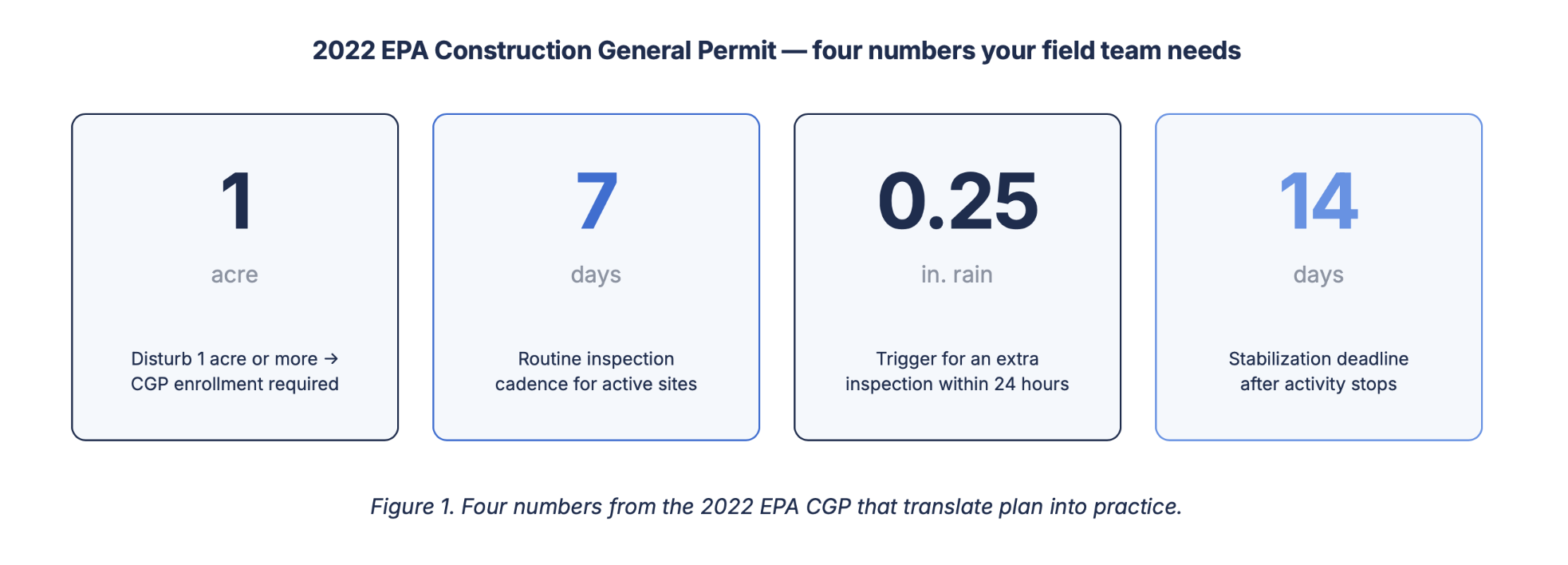
Three obligations matter most for field teams. Routine inspections every seven days for active sites, plus an additional inspection within twenty-four hours of any rainfall event of 0.25 inches or greater. Stabilization work must begin within fourteen days after construction activity stops in any portion of the site. Every BMP must be inspected, documented, and corrected if it is failing.
Legal exposure under the Clean Water Act runs up to $66,712 per day per violation. The dollar figure is not the headline. The unit is. A condition that goes uncorrected for three weeks is, in regulatory terms, twenty-one separate violations.
“SWPPP-complete,” meaning the plan is filed, is not the same as “SWPPP-compliant,” which describes the physical site. That is where most preventable Notices of Violation come from.
The CGP’s inspection cadence is built for one inspector and one site at a time. The reality of a homebuilder or land developer portfolio is different. A regional superintendent or area manager is responsible for multiple active sites in the same geographic area.
When a storm system rolls in, it hits all of them at once. The 0.25-inch threshold fires the inspection clock across the whole portfolio at the same time.
The compliance question on paper is whether the inspector reached each site within a specific time frame. The operational question on the ground is harder. Which sites need work right now? And just as important, which sites performed as expected, so the team can spend the day on the ones that did not?
Without a site-level signal across the portfolio, common patterns appear.
None of these are bad-faith behaviors. They are what a one-person, multi-site monitoring process produces in the absence of better information.
What the regional superintendent needs is a post-storm view of the whole portfolio at once: which sites moved, which BMPs likely failed, and which sites look the same as they did the day before. That last part matters as much as the first. Clear answers saying “these sites held up” is what frees the team to spend the morning on the ones that did not.
The SWWPP is built from the approved plan: proposed grades, drainage paths, BMP locations, inlet protection, and other controls based on how the site is expected to drain. Once grading starts, those assumptions can change. A cut extends beyond the planned limit. Fill settles unevenly. A design revision shifts a pad edge after.
These changes are part of normal field conditions. The risk starts when they alter drainage patterns, while the SWPPP records and controls remain tied to the original layout. As a result, a gap appears between the approved plan and the site as it exists today.
TraceAir gives you current site topography as grading progresses, so you can see where drainage has shifted before it becomes a compliance problem.
The EPA CGP is the federal floor. Most states operate their own programs that meet or exceed it, and the operational differences between them are bigger than the regulatory text suggests. Texas (TPDES through TCEQ) runs a structure modeled on the federal CGP, with its own NOI submission and inspection report formats.
Florida (FDEP) adds sensitivity in coastal counties tied to MS4 discharge requirements. California’s Construction General Permit layers a Risk Level system (1, 2, or 3) on top of the federal baseline that materially changes inspection frequency and numeric effluent limitations.
North and South Carolina each operate their own NPDES-delegated programs with state-specific inspection forms and BMP standards.
The implication for portfolios spanning multiple states is that a single national SWPPP template, no matter how well-written, will produce filing-correct documents that diverge from actual obligations on the ground.
A project manager who has run thirty Texas sites should not assume the cadence and forms will look the same when the company opens a Florida or California site. They will not. Portfolio-level oversight tools exist to make those divergences visible before they show up in an inspection record.
Stormwater compliance is a visibility problem dressed as a documentation problem. The inspection cadence prescribed by the CGP is, structurally, sampling rather than continuous coverage. Closing that gap is what separates builders who pay penalty prices from builders who pay rework prices, and further from builders who pay neither.
TAKE THE NEXT STEPIf you run a multi-site, multi-state earthworks portfolio and want to see what site intelligence looks like on your projects, book a demo with us. |
Weekly site walks can miss volumes, subcontractor errors, and documentation gaps. See how drone monitoring closes those blind spots.
Discover four effective strategies to enhance SWPPP management for site development projects, leveraging technology to reduce costs and improve...
Site intelligence gives land development teams visibility into grading, cut and fill, and progress to protect schedules without added headcount.