5 min read

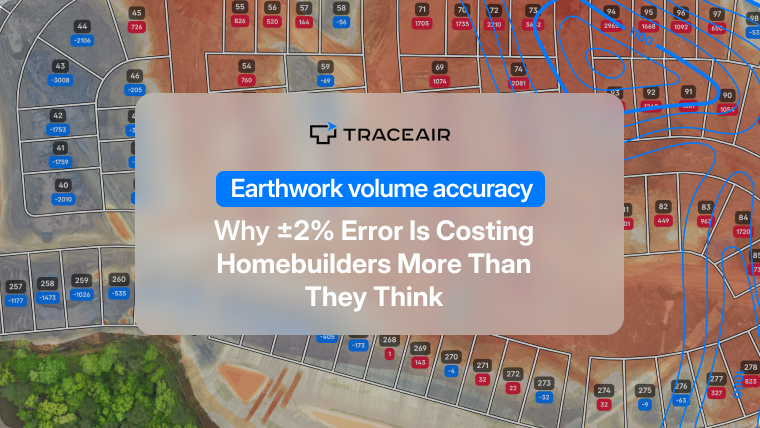
Earthwork Volume Accuracy: Why ±2% Error Is Costing Homebuilders More Than They Think

Earthwork Volume Accuracy: Why ±2% Error Is Costing Homebuilders More Than They Think
9:02

A 2% earthwork error on a 500-lot project isn't a rounding issue — it's a six-figure problem. Land teams know earthwork miscalculations are expensive. Few realize how fast a small percentage gap compounds across a large project until the schedule and budget are already blown.

This post breaks down where the error actually comes from, what it costs in real terms, and how the best site teams are closing the gap with better site visibility.

The Math Behind a 2% Error

Earthwork volume is measured in cubic yards. On a typical 500-lot land development project, you're moving anywhere from 500,000 to over 1 million cubic yards of material. The cost to move that dirt — including grading, hauling, and compaction — typically runs $4 to $8 per cubic yard depending on site conditions, haul distance, and market.

Run those numbers at 2% error:

Project Scale

2% Volume Error (CY)

Cost Exposure (@$6/CY avg)

200-lot project

~8,000 CY

~$48,000

500-lot project

~20,000 CY

~$120,000

1,000-lot project

~40,000 CY

~$240,000


That's just direct cost. It doesn't account for schedule delays, contractor disputes, or the cost of a dirt import you didn't see coming.

"The problem isn't that teams don't care about accuracy. It's that traditional methods make accuracy hard to achieve in the field, in real time."

Where the Error Comes From

Earthwork miscalculations don't usually happen because someone made a careless mistake. They happen because the data being used to make decisions is stale, incomplete, or measured too infrequently. Here are the four most common sources:

1. Infrequent Site Surveys

Traditional topographic surveys happen at the start of a project and maybe a few times during construction. Between surveys, volume tracking relies on manual estimates, contractor self-reporting, or nothing at all. A site can move significantly in two weeks — and the team won't know until the next survey.

2. Vegetation and Terrain Interference

Standard surveying methods struggle in vegetated areas. If your original ground topo was captured through brush or heavy grass, your baseline numbers are already off before the first blade of a grader hits the dirt. That error carries through every volume calculation that follows.

3. Soil Behavior: Swell and Shrink Factors

Dirt doesn't move in a 1:1 ratio. Cut material swells when disturbed, fill material shrinks when compacted. These soil behavior factors vary by material type and site conditions. Teams that use generic industry averages instead of site-specific tracking build cumulative error into every calculation.

4. Disputed Quantities at Billing Time

When a grading contractor submits a pay app based on their own volume numbers and your team has different data, you have a dispute. Without an independent, timestamped record of what was moved and when, these disputes are hard to resolve quickly — and slow billing holds up the whole project.


What Best-in-Class Site Teams Do Differently

The teams controlling earthwork costs most effectively share one operational habit: they measure more frequently. Not just at project start or at billing milestones, but on a regular cadence throughout construction. Here's what that looks like in practice.

Weekly Aerial Scans as Standard Practice

Leading land development teams are scheduling drone flyovers on weekly or bi-weekly cycles. Each scan produces a high-resolution 3D model of the site overnight — top-down orthophoto, elevation map, contours, and cut/fill map with live quantities. No waiting on a surveyor. No manual field measurements.

With TraceAir's aerial scanning platform, teams get a new site snapshot on a schedule that matches how fast the work is actually moving.

Cut/Fill Balance Tracking Between Scans

Rather than calculating a single total at the end of a phase, the best teams track running totals. They compare this week's scan against last week's scan to see exactly what moved — and what didn't. They compare against design grade to see how much cut or fill remains in each zone.

This kind of scan-to-scan comparison makes it easy to catch a balance problem early, before a contractor has moved material in the wrong direction for three weeks.

LiDAR for Complex Original Ground Capture

On sites with heavy vegetation or uneven terrain, standard drone photography can't penetrate the canopy to capture true ground elevation. LiDAR scanning — which uses laser pulses to measure through gaps in vegetation — gives teams a defensible original ground baseline that downstream volume calculations can actually rely on.

Field-Accessible Tools, Not Just Engineer Reports

Earthwork data is only useful if the people making decisions can access it. The best platforms put cut/fill volumes, surface comparisons, and haul planning tools in the hands of the project manager, the foreman, and the superintendent — on a phone or tablet, in the field, in real time. Not in a report that gets emailed three days after the meeting where the decision was already made.


The Compounding Cost of Getting It Wrong Late

There's a timing dimension to earthwork error that often gets overlooked. A 2% volume miscalculation caught at week 2 of grading is manageable. The same error caught at week 10 — after a contractor has been paid based on wrong numbers, after a dirt import has been planned based on wrong balance projections, after a schedule has been built around assumptions that don't match the ground — is a much bigger problem.

Earthwork errors don't just cost money. They cost options. The later you find out, the fewer choices you have.

This is why frequency of measurement matters as much as accuracy of measurement. A team with weekly scan data and 1% error tolerance has more runway to course-correct than a team with quarterly surveys and 0.5% error tolerance.

How TraceAir Closes the Gap

TraceAir's land development platform is built around this problem. Here's specifically how it addresses the four sources of error outlined above:

  • Infrequent surveys → Overnight aerial scans on a regular schedule, with a 3D site model ready the next morning
  • Terrain interference → LiDAR for vegetated and complex sites, capturing true bare-earth elevation even through dense canopy
  • Soil behavior uncertainty → Soil behavior tracking that gets more accurate with every scan, using site-specific bulk/shrink data instead of generic factors
  • Billing disputes → Scan-to-scan comparison with timestamped, independent records of what moved and when — ready to pull up in any contractor meeting


The result: teams catch balance problems earlier, resolve disputes faster, and go into every billing conversation with numbers they can defend.


Frequently Asked Questions

Ready to See What Your Site Is Actually Doing?

TraceAir gives land development teams overnight aerial site data, cut/fill tracking, and field-ready tools to catch earthwork problems before they become budget problems. Whether you're managing a 50-lot infill or a 1,000-lot master-planned community, accuracy at scale starts with data you can trust.

→ Request a Demo


Every Land Developer's Worst Nightmare

1 min read

Every Land Developer's Worst Nightmare

That's it. A large stockpile. A big stockpile at the end of a construction project is every developer's worst nightmare. Land developers are...

Read More
Site Monitoring: How TraceAir Helped Save $800K on Earthwork

Site Monitoring: How TraceAir Helped Save $800K on Earthwork

Land development teams do not just need to know that work is happening. They need to know whether the right work is happening, in the right place,...

Read More
Overcoming Lot Supply Shortages with TraceAir’s Competitive Advantage

3 min read

Overcoming Lot Supply Shortages with TraceAir’s Competitive Advantage

Land acquisition teams across the country are in desperate search of lots to build on. The first quarter of the year has seen a significant...

Read More