5 min read
Layout Generator: How It Improves Your Land Evaluation Process
TraceAir Technologies Inc. April 16, 2026
Land acquisition teams cannot afford to wait too long for clarity. They need to evaluate parcels, test feasibility, and prepare smarter land offers while opportunities are still active.
TraceAir’s Layout Generator gives them a more useful first-pass view of a site ahead of formal engineering. With parcel data, zoning inputs, lot controls, wetlands, FEMA flood maps, slope, and other site constraints in view, teams can compare scenarios, generate lot counts, and understand what’s actually buildable before committing to due diligence.
For homebuilders and residential developers, that means faster screening, earlier risk visibility, and more confidence in the logic behind an offer. This article shows how Layout Generator supports that process.
How Layout Generator Improves Site Feasibility
Early parcel evaluation often breaks down because the process is fragmented. Teams review aerials, do rough math, request a quick concept, and wait while the deal keeps moving. That leaves important decisions tied to incomplete visibility.
The result is more than delay. Teams spend time on weak sites, carry forward yield assumptions that may not hold up, and struggle to explain recommendations with confidence. Too much of the logic stays verbal until later-stage review.
Layout Generator improves that stage by giving land teams a realistic first-pass view earlier. Instead of waiting for engineering to create the first real point of clarity, teams can test access, lot mix, site constraints, and likely yield while the deal is still active.
As Santos Pérez Ramírez, Land Entitlement Project Manager at Mungo Homes, explained, the value lies in how quickly teams are able to explore real options.
I looked at it and realized that, in a couple of minutes max, I could have multiple different layouts of any piece of land that I was really interested in.
That speed makes it easier to evaluate more sites, contrast scenarios quickly, and focus attention on the opportunities that deserve a closer look. As a result, teams can eliminate weak sites sooner, build stronger pricing logic around the right opportunities, and align internal stakeholders around a more credible recommendation. In a market where speed matters but bad assumptions are costly, this creates a meaningful advantage.
What Slows Down Early Feasibility?
Early feasibility issues are not always obvious at first. The table below breaks down where delays, weak yield visibility, and misalignment tend to surface.
| Delay | Weak Yield Visibility | Seller & Leadership Conversations |
| Slower deal review | Rough lot count assumptions | Harder to defend the offer |
| More time on weak parcels | Constraints show up too late | Less confidence internally |
| Slower early decisions | Yield changes later | Tougher seller conversations |
| More back-and-forth | Product fit is unclear | Leadership get less clarity |
From Parcel Search to Yield Insight
Layout Generator supports more than layout creation. It fits the real land acquisition workflow by helping teams move to early feasibility review in one environment.
Using parcel search and filtering, teams are able to define a target area and narrow opportunities based on practical inputs such as zoning. Rather than spending time on every parcel that looks promising at a glance, they can focus on sites that already align with basic criteria.
Once a site looks viable, teams can test layout scenarios, adjust lot sizes, explore product mix, and revise assumptions to understand how zoning, parcel geometry, and site constraints shape likely yield.
Layout Generator gives land teams earlier visibility into site potential, improves offer quality, reduces guesswork, supports tighter pricing logic, and strengthens the basis for internal recommendations ahead of engineering review.
Watch this webinar video to see how it works in practice.
Why Realistic First-Pass Layouts Matter
Recent updates make first-pass layouts more grounded and more useful as decision tools. Teams can define minimum lot dimensions, account for setbacks and building footprints, and generate layouts that better reflect whether the intended product actually fits the site.
Road-width controls strengthen that view by making circulation part of the land-use logic instead of a rough sketch. Teams can also test different housing forms, including townhome configurations, by adjusting unit-count parameters and comparing how product mix affects site fit.
These updates matter because early parcel evaluation is not a one-time answer. It is a sequence of tradeoffs. Layout Generator helps teams test those tradeoffs faster and with more truthful assumptions prior to detailed engineering.
Working with Wetlands, FEMA Flood Maps, and Other Site Constraints
Many early land assumptions break down once real site constraints come into view. Wetlands, floodplain exposure, slope, contours, and restricted access can quickly change usable area, roadway logic, and likely yield.
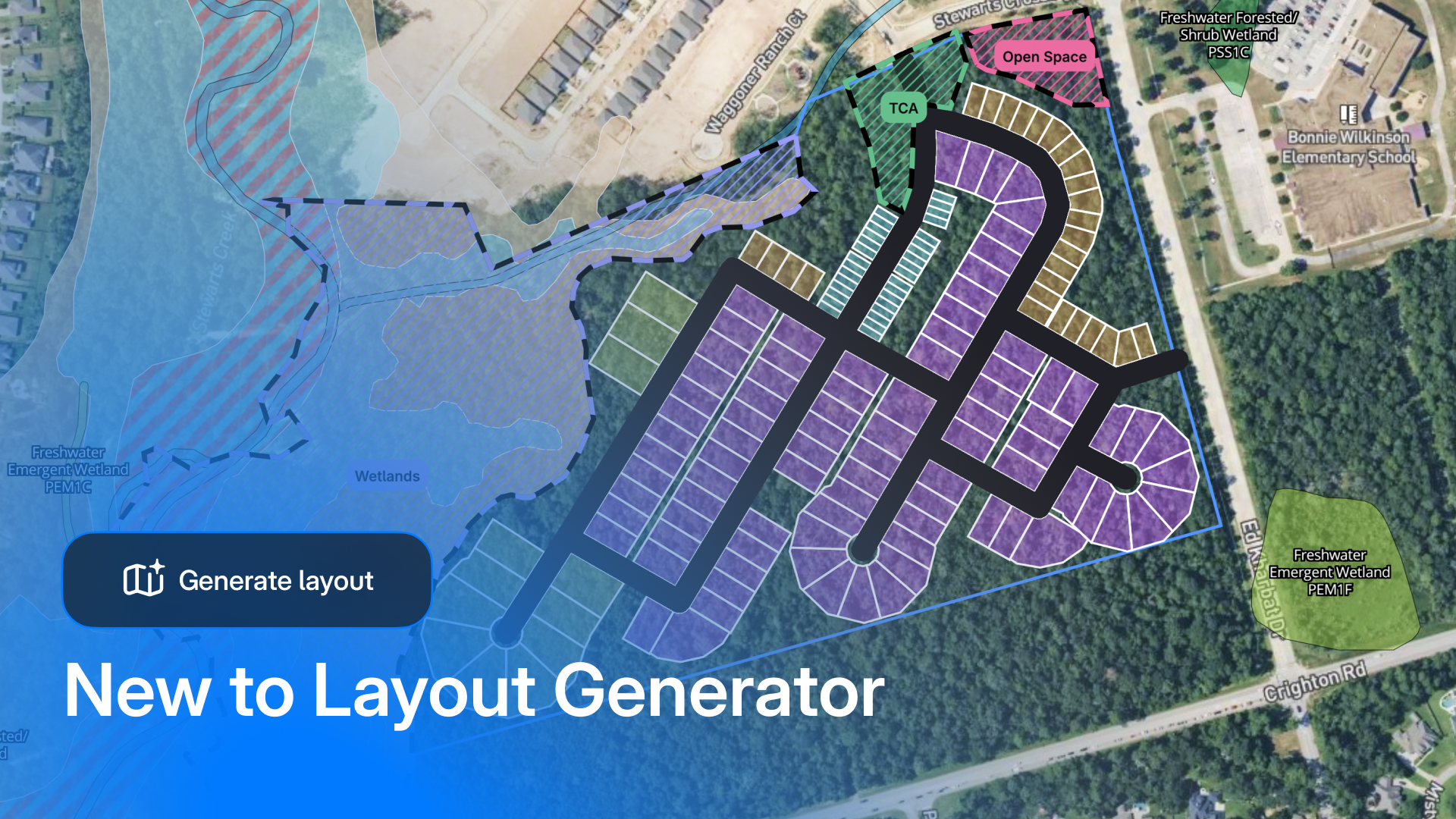
Layout Generator brings those constraints into the first pass. Teams can review satellite imagery, work with GIS layers such as wetlands and FEMA flood maps, mark restricted areas, and use measurement tools to understand how much of the parcel is affected.
That improves feasibility work in a practical way. Instead of discussing constraints abstractly or carrying weak assumptions too far into pricing, teams can evaluate the site with clearer visibility from the start.
How Better Site Insight Supports Better Decisions
Moving feasibility earlier does more than speed up the process. It helps land acquisition teams evaluate sites more clearly, shape stronger offers, and support internal decisions while the deal is still active.
- Better site screening: Teams can compare scenarios earlier, rule out weaker opportunities faster, and spend more time on parcels with a more accurate path forward.
- Stronger land offers: A visible first-pass layout brings more structure to pricing discussions by grounding recommendations in a likely yield, site constraints, and clearer tradeoffs.
- Clearer team communication: Exportable layouts to make it easier to explain the rationale behind a recommendation in seller conversations, leadership reviews, and internal handoffs, so decisions are easier to support and move forward.
A More Effective Alternative to the Traditional Process
Layout Generator provides a better model for early feasibility, rather than simply speeding up the process. In a traditional workflow, the acquisition team forms an initial view with partial information and then waits for engineering support to produce the first credible layout. That slows momentum and increases the risk of overconfidence built on weak assumptions.
Layout Generator gives land teams a more reasonable first-pass view of likely yield by incorporating zoning, lot dimensions, roadway logic, and site constraints earlier in the process. It does not replace engineering. It improves the handoff into it by giving both acquisition and development teams a stronger starting point.
Watch this webinar clip to see how teams build a clearer first-pass view of site yield before deeper engineering review begins.
Building More Defensible Land Offers
For land teams, speed matters, but the bigger advantage is being able to price opportunities with greater confidence before formal engineering starts. Layout Generator supports that by helping screen parcels, shape offers, and back recommendations with layouts instead of rough assumptions.
This leads to a more disciplined land evaluation process, with better focus on the right opportunities, smoother alignment with internal stakeholders, and offers that are easier to support in leadership reviews and seller conversations.
For homebuilders and residential developers, that means evaluating land faster, making more informed decisions, and putting forward land offers that are easier to support.
See how Layout Generator works on your actual parcels, zoning rules, and site constraints so you can evaluate land more effectively and move forward with a clearer basis for action.
Frequently Asked Questions
-
What is Layout Generator?
Layout Generator is a modern early-feasibility workspace that helps teams turn raw land into lot yield estimates in minutes. It allows users to sketch conceptual subdivision layouts, visualize site constraints, estimate yield, and test site potential before moving further into the deal.
-
Who is Layout Generator built for?
Layout Generator is built primarily for land acquisition teams that need to evaluate whether a tract is worth bidding on. It is designed for early-stage decision-making, when teams need a faster and clearer view of site potential before due diligence begins.
-
How does Layout Generator help teams evaluate a tract early?
It gives teams a fast, visual way to test a site’s potential yield before involving engineers. Instead of relying on manual sketches or rough estimates, teams can generate conceptual layouts, test assumptions, and get a clearer sense of what may be buildable early in the process.
-
What can teams model with Layout Generator?
Teams can model multiple layout scenarios using different lot sizes, housing types, depths, widths, roadways, and alleys. This makes it easier to compare configurations, generate lot counts, and understand how different design assumptions affect the tract.
-
How does Layout Generator account for site constraints?
Layout Generator helps teams visualize environmental, grading, and zoning constraints directly on the site. It also supports overlays such as slopes, wetlands, FEMA zones, streets, and NAIP imagery, and lets users draw added constraints like parks or community areas so yield estimates are grounded in what is actually buildable.
-
How does Layout Generator help teams compare scenarios faster?
Layout Generator lets teams adjust constraints on the fly, test multiple configurations in real time, and instantly recalculate usable land, road footage, lot mix, total yield, and constraint impacts. Teams can also save layouts, revisit revisions, and export CAD files or PDFs for easier sharing and review.