



The houses are framed, trimmed, and cleaned. Driveways are in. Buyers are circling. And then everything stops—because the meters aren’t hot.
In California, energization is where schedules break down. The utilities—PG&E, SCE, and SDG&E—demand complete, accurate submissions. No shortcuts, no assumptions. Too often, projects fall apart in the details: missing documentation, shifted meter locations without updates, missed inspections. What should be a handoff becomes months of delays.
A dark house is a perfect product you can’t sell. Appliances sit wrapped, certificates of occupancy wait, and carrying costs pile up while revenue stalls. When this compounds across an entire development, a quarter's numbers collapse for entirely preventable reasons.
California adds its own complexity. Jurisdictions layer unique inspection sequences on top of utility requirements. Off-sites and joint trenches introduce more hand-offs. The result is the same across the state: if the packet isn’t airtight the lot bounces, and every bounce pushes closings further out. The fastest divisions aren’t “lucky” with utilities; they prove readiness on day one. Teams that run airtight sequencing and have the ability to share complete, lot-level documentation power on faster, reduce rejections, and protect division revenue.
Where do energization schedules actually break?
The short answer: in the hand-offs.
Trench photos get emailed to a busy coordinator and disappear. A meter shifts in the field but never makes it onto the plan the reviewer sees. As-builts reflect last week’s intent, not today’s conditions. None of these are catastrophic alone, but together they introduce doubt—and doubt triggers a bounce: “please clarify” while your crew has already backfilled and moved on.
California multiplies the effect. Cities and counties run different inspection sequences, and joint trenches tie electric, comms, and off-sites into one chain. Miss a single step—trench proof before backfill, compaction before paving, meter set before final—and the utility can’t advance. Each bounce slides energization, slips closings, and, across a tract, nudges an entire quarter the wrong way.
What makes a “ready-for-utility” packet in California?
Reviewers need two answers: “Where is everything supposed to go?” and “Can the crew install it today?” Give them clarity without any gaps.
That means current photos tied to the lot, plan overlays that align with the field, and a simple exhibit that shows the install path is clear. If something’s in the way, name it, clear it, and include a before/after so no one has to guess.
How TraceAir helps California builders prove utility readiness and speed up energization
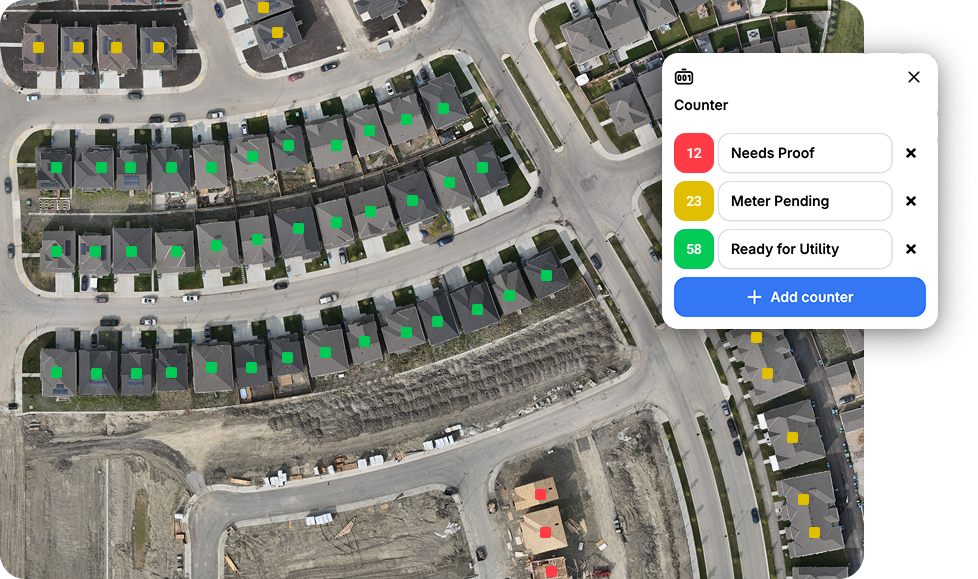
TraceAir makes day-one readiness repeatable. Crews capture trench and meter evidence as they work; every photo is time-stamped and pinned to the lot. Plans live as an overlay on the same map, so intent vs. reality is obvious. Lot Viewer draws clean lot lines, and a color-coded Counter shows status at a glance — learn more about TraceAir's site preparation tools.
The backlog may be long, but your submission stops being the reason it stalls.
.png)
What does this change in real terms?
Powering on faster in California comes down to removing doubt: when trench and meter proof is captured once, time-stamped, and tied to the correct lot, when plan overlays match what’s actually in the ground, and when a simple overlay-plus-exhibit shows the install path is clear, reviewers don’t have to guess and packets don’t bounce. With lot-by-lot visibility—made obvious by clean parcel lines and a color-coded status counter—and a quick trench-length check against plan before you submit, energization stops being a chain of clarifications and becomes a scheduled step that moves through PG&E, SCE, and SDG&E the first time. The practical outcome is fewer emergency re-walks, fewer re-submittals, and a steadier line from packet to power-on, which keeps closings on the calendar and revenue landing when it should.